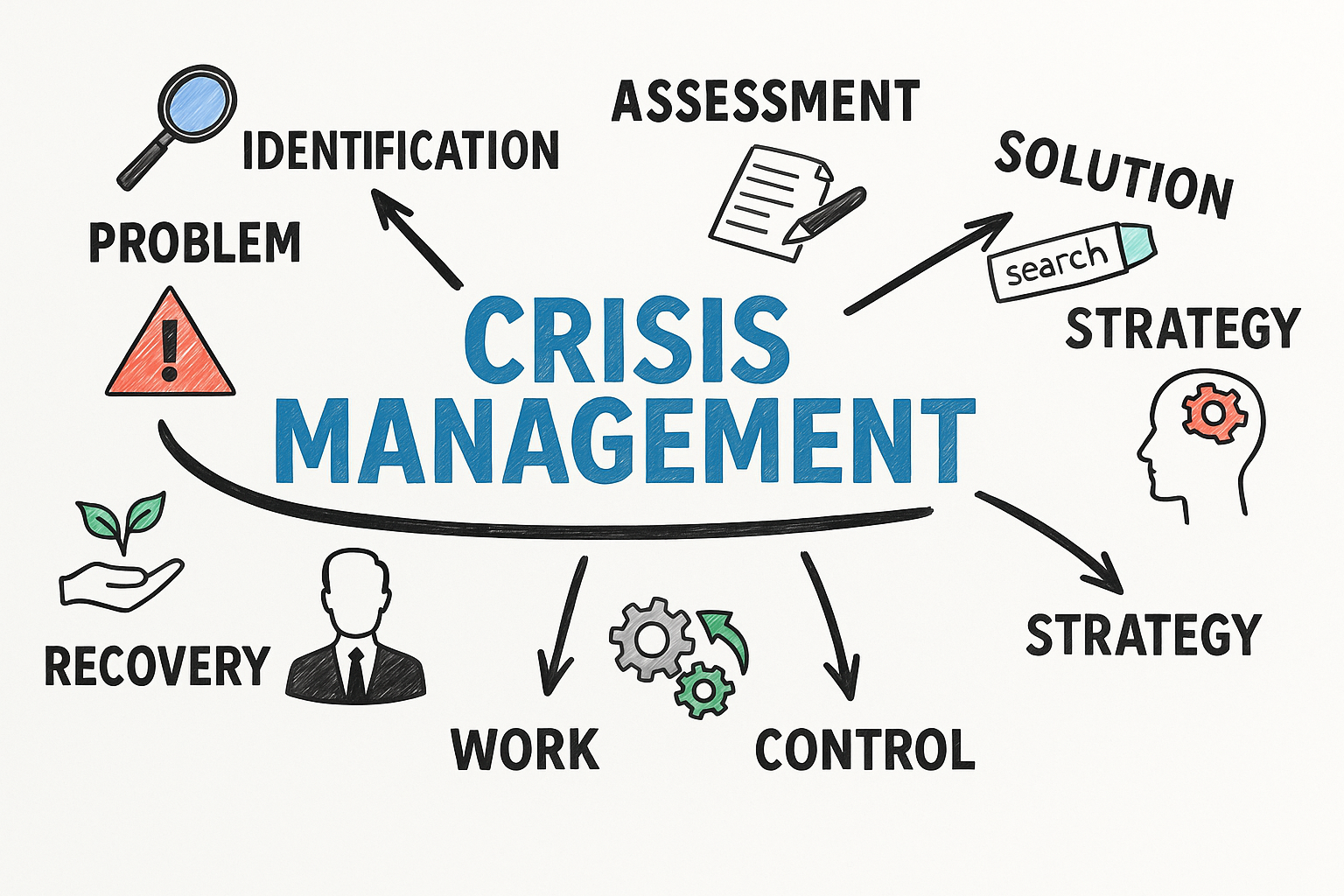
Comprehensive Business English Guide: Crisis Communication & Reputation Management
1. Core Crisis Communication Vocabulary
| Term | Definition | Example Sentence |
| Contingency plan | Pre-prepared crisis response | “Our contingency plan outlines media protocols.” |
| Stakeholder mapping | Identifying affected parties | “Stakeholder mapping revealed investor concerns.” |
| Holding statement | Initial brief response | “We issued a holding statement within 30 minutes.” |
| Damage control | Minimizing negative impact | “The PR team initiated damage control measures.” |
| Transparency | Open, honest communication | “Transparency builds trust during recalls.” |
| Hotline | Dedicated crisis contact | “Activate the employee hotline for questions.” |
| Fallout | Negative consequences | “The financial fallout exceeded projections.” |
| Rebuttal | Counterargument to criticism | “The CEO delivered a factual rebuttal.” |
| Walkback | Retracting a statement | “The walkback confused customers further.” |
| Goodwill bank | Reserve of public trust | “Our goodwill bank helped weather the scandal.” |
2. Crisis Communication Framework
A. Immediate Response (0-24 Hours)
Key Phrases:
- “We are aware of the situation and investigating urgently.”
- “Our priority is [safety/accuracy/service continuity].”
- “We will provide updates at [time/channel].”
B. Ongoing Management (24-72 Hours)
Key Phrases:
- “Here’s what we know so far…”
- “We’ve taken these corrective actions…”
- “We regret any inconvenience caused.”
C. Recovery Phase (1 Week+)
Key Phrases:
- “Lessons learned include…”
- “Our new safeguards prevent recurrence.”
- “We invite independent verification of…”
3. Sensitive Situation Language
A. Taking Responsibility
- “We fell short of our standards.”
- “We accept full responsibility for…”
- “This should not have happened.”
B. Avoiding Liability (Legal Considerations)
- “We’re reviewing the circumstances surrounding…”
- “Our records indicate…”
- “We’ve retained external experts to…”
C. Media Interview Responses
- “Let me clarify three key points…”
- “What I can confirm is…”
- “We’re focusing on solutions, not blame.”
4. Phrasal Verbs for Crisis Management
| Phrasal Verb | Meaning | Example |
| Backpedal | Reverse position | “The spokesperson backpedaled under pressure.” |
| Beef up | Strengthen | “We’re beefing up compliance checks.” |
| Blow over | Pass without major impact | “With transparency, this will blow over.” |
| Clamp down | Enforce strictly | “We’ll clamp down on policy violations.” |
| Face up to | Acknowledge responsibility | “Time to face up to the supply chain flaws.” |
| Fend off | Deflect criticism | “The legal team fended off lawsuits.” |
| Own up | Admit fault | “Better to own up early than conceal.” |
| Smooth over | Reduce tensions | “Compensation smoothed over customer anger.” |
| Stave off | Prevent temporarily | “Quick action staved off resignations.” |
| Weather | Survive difficulties | “Strong brands weather crises better.” |
5. Crisis Communication Idioms
| Idiom | Meaning | Example |
| Back against the wall | In a difficult position | “With recalls and lawsuits, we’re against the wall.” |
| Damage is done | Irreversible harm | “The data leak’s damage is done—now we rebuild.” |
| Fire drill | Chaotic emergency response | “The breach created a PR fire drill.” |
| In the hot seat | Under intense scrutiny | “The CFO was in the hot seat at the hearing.” |
| Keep lid on | Contain information | “We can’t keep the lid on this scandal.” |
| Out of the woods | Past the danger | “Stock prices show we’re not out of the woods.” |
| PR nightmare | Severe reputation damage | “The video went viral—total PR nightmare.” |
| Save face | Protect reputation | “The donation helped save face locally.” |
| Throw under the bus | Blame unfairly | “Don’t throw junior staff under the bus.” |
| Wake-up call | Warning to improve | “Treat this as a wake-up call for audits.” |
6. Scenario-Based Responses
Data Breach Example
Holding Statement:
*”We’ve detected unauthorized system access and engaged cybersecurity experts. While we investigate, we recommend password resets. A dedicated team is available at 1-800-HELP (24/7).”*
CEO Message (1 Week Later):
“We failed to protect your data. New encryption and third-party monitoring are now in place. All affected customers receive free credit monitoring.”
Product Recall Example
Initial Alert:
“Out of abundance caution, we’re recalling Lot #X23. Return for full refunds or replacements. No illnesses reported, but safety comes first.”
Follow-Up:
“The faulty component came from Supplier Y, now replaced. Our upgraded quality controls exceed industry standards.”
7. Practice Exercises
Exercise 1: Rewrite Defensive Statement
Original:
“This isn’t our fault—the contractor mislabeled materials.”
Improved:
“We’re addressing the mislabeled materials issue with our supply chain partners. Immediate corrective actions include…”
Exercise 2: Draft Holding Statement
Situation: Factory fire with no injuries but production halted.
Template:
“We’re responding to an incident at our [Location] facility. All employees are safe. Production will resume at alternate sites next week. Updates: [Website/Phone].”
Exercise 3: Media Q&A Prep
Tough Question:
“How long did you know about the safety risks?”
Response Framework:
- Acknowledge (without admitting guilt)
- Redirect to solutions
- Bridge to positive action
“We continuously monitor safety data. When this pattern emerged, we immediately [actions taken]. Our focus now is [preventative measures].”
8. Reputation Recovery Strategies
- Timeline
- Hour 1: Acknowledge crisis
- Day 1: State actions taken
- Week 1: Show progress
- Month 1: Demonstrate change
- Channels
- Press conferences
- Social media FAQs
- Employee talking points
- Investor briefings
- Tone Guidelines
- Regretful but not defensive
- Concise yet thorough
- Forward-focused
Final Tip:
For crisis simulations:
- Assign roles (CEO, PR, Legal)
- Practice responding to hostile questions
- Record and analyze body language